
Everest base ca mp trekking is undoubtedly one of the most renowned travel destinations in the world. For adventure travelers it’s an exciting opportunity to be at the foot of world’s highest mountain – Mount Everest (8848m/29029ft) and high Himalayas. Generally speaking the international agency will be paying staff in other countries while a Nepali agency will be paying local staff. The result with hiring via a Nepali agency is that your costs will be lower compared to that of international agency and yes of course you are helping the local economy too. It’s worth considering a local Nepali trekking agency over an international agency. The Nepali trekking agencies prices range per person from USD $1,200 to $1,700 according to customization of trip by trekkers for an average 12 – 15 day trek. Trekking directly with guide costs even lesser but if you want to trek with full of joy, comfortable, security and unexplainable accomplishments then planning a trek via trekking company is highly recommended, because if anything happens to guide, then whom would you contact to? If you have any problem then an agency is a quicker and will organize a helicopter service if needed, multiple alternative ways and than a guide. Such package treks include various permits, round trip flights from Kathmandu to Lukla, accommodation, meals. Likewise in brief such cost packages includes;Everest base camp trekking is undoubtedly one of the most renowned travel destinations in the world. For adventure travelers it’s an exciting opportunity to be at the foot of world’s highest mountain – Mount Everest (8848m/29029ft) and high Himalayas. Generally speaking the international agency will be paying staff in other countries while a Nepali agency will be paying local staff. The result with hiring via a Nepali agency is that your costs will be lower compared to that of international agency and yes of course you are helping the local economy too. It’s worth considering a local Nepali trekking agency over an international agency. The Nepali trekking agencies prices range per person from USD $1,200 to $1,700 according to customization of trip by trekkers for an average 12 – 15 day trek. Trekking directly with guide costs even lesser but if you want to trek with full of joy, comfortable, security and unexplainable accomplishments then planning a trek via trekking company is highly recommended, because if anything happens to guide, then whom would you contact to? If you have any problem then an agency is a quicker and will organize a helicopter service if needed, multiple alternative ways and than a guide. Such package treks include various permits, round trip flights from Kathmandu to Lukla, accommodation, meals. Likewise in brief such cost packages includes;• Airport pickup and drop services by private vehicle.• 3 star Hotel in Kathmandu on twin share and food.• Kathmandu sightseeing tour with guide, entrance fees.• Flights from Kathmandu-Lukla-Kathmandu.• Sagarmatha National Park entrance fees.• Trekking guide, porters.• Daily wages and insurance of guide and porters.• Staying in local lodges while on trek.• Breakfast, tea, lunch and dinner on trek.• First-aid kits and communication devices (with guide) on trek.• Waterproof duffel bag for your trekking kits (yours to keep).• T-shirts, caps of company (may or may not provide) (for you if provided).• Down jackets, sleeping bags and related materials (have to return after trek).Note: The package won’t include your travel insurance, international flight fare, Nepal visa fees and trekking equipment’s.Apart this, there are several short packages and low budget packages too which didn’t offer you wide range of facilities. There are low budget packages ranges from USD $700 to $1200 according to your modification of trek. The different between various packages services is that packages costing above USD $1200 provides you accommodation in tea house and all meals (breakfast, lunch and dinner) in Kathmandu and during the trek. But packages costing below USD $1200 allows you and should have to pay all the expenses of their meals and accommodation in tea house while you’re in trekking days by themselves. Regard this, whichever packages you choose the Everest base camp trek offers you wide range of unexplainable and lifetime accomplishments.
A Complete Guide To Upper Mustang Trek
 Mustang is a part of Dhaulagiri Zone is one of the seventy-five districts of Nepal, a landlocked country of South Asia. Jomsom as its headquarters covers an area of 3,573 km² and has a population of 14,981 according to 2001 census. Mustang straddles the Himalayas and extends northward onto the Tibetan plateau. Upper Mustang, the former Lo Kingdom comprises the northern two-thirds of the Mustang district. This kingdom was a dependency of the Kingdom of Nepal but was abolished by the republican Government of Nepal on October 7, 2008. Mustang is a remote sub-kingdom within the Himalayan region of north-central Nepal. The name “Mustang” is derived from the Tibetan word meaning, “Plain of Aspiration”. The entire district lies within the Annapurna Conservation Area, the largest protected area in Nepal. The people of Mustang are ethnically Tibetan; the population is only about 15,000 totals. Most live along the banks of the Kali Gandaki River, once a major trade route through this mountainous region. Untouched by modern civilization, isolated in its rugged mountain terrain, a way of life persists here in Mustang that is fast disappearing in Tibet proper.
Mustang, an isolated part of Nepal, has caves, hikes and royals. Sheltered by some of the world’s highest mountains, the 8000-meter peaks of Annapurna and Dhaulagiri, bordering China and the Tibetan plateau, Mustang is ancient forbidden kingdom, where strict regulation of travelers helped Tibetan traditions survive stronger than Tibet proper. Upper Mustang was a restricted demilitarized area until 1992, which makes it one of the most preserved regions in the world due to its relative isolation from the outside world, with a majority of the population still speaking traditional languages. The monarchy in Mustang ceased to exist on October 7, 2008, by order of the Government of Nepal, after Nepal became a federal democratic republic.Since Mustang is shadow of the Himalaya, Mustang has much less rain then the rest of Nepal. It is one of the few places in the world that has long-lived and a very close-niche life, as it has remained inaccessible to outsiders. This isolation helped the people of Mustang to maintain their lifestyle and heritage that remained almost unchanged for centuries. Hidden behind the majestic Himalayan ranges of Dhaulagiri and Annapurna, Mustang is filled with beautiful trekking zones. The tourists require permits to visit this region. Mustang where lies the ancient Buddhist kingdom of Lomanthang. Trekking in Mustang gives you a similar feeling of trekking in Tibet.
Mustang trekking is one of Nepal’s most mysterious and least known kingdoms, where we can explore a weird and wonderful landscape of eroded conglomerate cliffs, colored by natural earth pigments – reds, yellows, browns and blues. It is really a picturesque like a white painted villages and Tibetan monasteries, which set against a backdrop of the distant snow-capped peaks of the Himalayas. some of the most popular destination in Mustang are as follows:
Check Mustang Trekking Package
Jomsom: It is located at an altitude of 2800m is more correctly known as Dzongsam or New Fort. It spreads over both the banks of the Kali Gandaki. The towering peaks of Dhaulagiri and Nilgiri form an attractive backdrop. Being the district headquarters, it is primarily an administrative and commercial center with government officials and merchants rubbing shoulders with the local inhabitants of the region, known as the Thakali. It has a wireless station, a police station, a bank, a hospital and a veterinary hospital. A company of the Nepalese Army is stationed here. Nearby is an airfield, from where flights operate regularly. However, due to the strong winds that buffet the area in the afternoons, the airfield is functional only in the forenoon. Jomsom is served by 6-8 flights a day. Regular visitors know that the flights are dependent on weather conditions. Though this is a remote area, private initiative in the form of many domestic airlines operates frequent flights to the area. Flight reliability and frequency are generally higher to Jomsom than to any other remote area in Nepal. It offers you harsh climatic conditions, glaring sun during the day, heavy winds and cold nights. This is a unique experience for the more than 50,000 visitors to Jomsom in a year – most of them repeat visitors.
Check Jomsom Valley Trekking Package
Muktinath Temple: It is a sacred place both for Hindus and Buddhists located in Muktinath Valley at an altitude of 3,710 meters at the foot of the Thorong La mountain pass (part of the Himalayas), Mustang district, Nepal. The site is close to the village of Ranipauwa, which sometimes mistakenly is called Muktinath as well. Within Hinduism it is called the sacred place Mukti Chhetra, which literally means the “place of liberation or moksha”. This temple is considered to be the 105th among the available 108 Divya Desam, which are considered sacred by the Sri Vaishnava cult. For Tibetan Buddhists, Muktinath-Chumig Gyatsa is a very important place of Dakinis, goddesses known as Sky Dancers and one of the 24 Tantric places. They understand the murti to be a manifestation of Avalokitesvara.
Lo Manthang: It is situated in the district of Mustang, which offers a range of exotic cultural experiences. Lo Manthang has only relatively recently been visited by foreigners, and the numbers of visitors to Upper Mustang are still restricted. Due to this, the culture here is almost untouched, making it an incredible site to visit. When visiting, you will most likely walk the direct trade routes from the 15th Century, and explore some of the richest Buddhist culture to be found in the country. The annual Tiji Festival usually takes place in May, and is one of the most important events on the cultural calendar. This three day ritual is centered on the Tiji myth, and is well worth attending if you arrive at the right time. Mustang offers wide range of culture and traditions, unseen and rare panorama which makes your itinerary worth in a lifetime.
Beside the Places mention above, there are more more places that you can explore in Mustang and to name few of them are as Fallows
Kagbeni
Sky caves
Chungsi cave
Chhoser
Best Time To Visit Mustang Valley
From the beginning of March to late December Is the Best Time To Visit Mustang Valley. Beside that October and November are also the highly recommended month to discover Upper Mustang in autumn.
Mustang Tiji festival Celebration
May is the perfect time If you are Planning To celebrate Tiji festival in upper mustang with locals. Tiji festival celebration date are fixed according to the Tibetan lunar calendar by monks and celebrated for 3 days.since Tiji festival Celebration dates are depend on Tibetan lunar calendar, so feel free to contact us for dates, itinerary and for any other useful information.
Packing List For Mustang Valley Trek
Really, in the event that if you are under confusion upon requirements before pursuing the trek than counseling with trekking office or different specialists can satisfy your prerequisite of pressing. At the time of finalizing bag packing don’t disregard to incorporate First guide unit, standard prescriptions, dozing pack, entire required categories of wears, travel reports and documents, cash money and alternatives more others including individual requirements. On the off chance that you are trekking off-season in winter than honestly incorporate some more thick wear outs
For More information You Can Fallow this Link A Complete Packing List For Trekking In Nepal
Difficulty level of Mustang Valley Trek
Honestly, Mustang Valley Trek covers extremely high elevation besides that luckily it’s not terribly complicated to achieve along not easy too. The moderate level of trekking destination claims lofty hiking, cycling, uphill climbing, camping, muscles stretching and an aerobic workout directly for assisting to establish as a capable trekker for Dhaulagiri trekking. However, normal people neglecting hard works can’t achieve the aimed destination. Remember, sometimes natural calamities can be the issue to append difficulty to the trek so preparation must be lofty.
Trekking with us
Safety: The most engaged reason uttered by potential and expert trekkers in the wake of joining with us is secured and successful trip with safe takeoff.
Guide: Contribution of guide (characteristics holding great information of whole spaces alongside high scope of English talking power) for building up trip more magnificent and wonderful.
Genuine adjustment: It’s really a difficult task to discover and design out the ideal goals for working orderly and ground-breaking trips inside the time. For that, organizations can help to the pointed goals with genuine adjustment.
Data: truth be told, there are incalculable secret attractions on the way holding diverse certainties and mind blowing legends along missing them is completely disregarded while trekking with us.
How to apply for Nepal visa?
 To travel in Nepal Visa is necessary for every country citizen except Indian citizen. The easiest process to get a tourist visa or other visa for Nepal is by applying on your arrival in Kathmandu at Tribhuwan international airport (TIA). To obtain a visa upon arrival by air in Nepal you must fill in a visa application form and provide a passport photograph. For your ease you can apply in advance at one of Nepal’s foreign consulates. You can also submit online visa application form at https://online.nepalimmigration.gov.np in advance from abroad. Here are the necessary documents required obtain your Nepal visa.
1. Original travel document with at least 6 months validity.
2. At least 2 blank visa page remaining
3. A copy of travel document ID page.
4. One recent passport-size photograph.
5. Duly filled in and signed visa application Form.
So you can either apply for a visa at a Nepal’s official immigration website before traveling or purchase a tourist visa upon arrival at Tribhuwan International Airport (TIA).
Where is Mount Everest located?
 Mount Everest is the highest peak on the earth and known as Sagarmatha in Nepali and Chomolungma in Tibetan. Most people often get confused about the exact location of Mount Everest. The world’s highest mountain peak is located in Mahalangur Himal sub-range of the Himalayas. The international border between China (Tibet autonomous region) and Nepal runs across its summit point. The geographical location of Everest is 27°59’ North latitude, 86°55’ East longitudes about 160.51 km from the Kathmandu which is equal to 99.74 miles, and 86.61 nautical miles. It is situated in the Himalayas, the 1500 mile (2414 kilometer) long mountain range that was formed when the Indo-Australian plate crashed into the Eurasian plate. On the Nepal side, Mount Everest is located in the Sagarmatha National Park in the Solukhumbu District. On the Tibetan side, Mount Everest is located in Tingri County in the Xigaze area, what China considers to be an autonomous region and part of the People’s Republic of China. Because of political restrictions and other factors, the Nepali side of Everest is most accessible and more often in the spotlight. When someone says they are going to “Everest base camp trek,” they are talking about South Base Camp at 17,598 feet in Nepal. Known for catching the attention of many enthusiastic climbers, people from all across the globe have always wanted to know venture around this nature’s gift.
The political map of Nepal has listed Mt. Everest in the ward number 4 of Khumjung Village Development Committee of Solukhumbu District in Sagarmatha zone. It is surrounded by a number of peaks, including Lhotse (8,516 meters), Nuptse (7,855 meters) and Cho Oyu (8,188 meters) and various other high Himalayas. The name Everest was attributed after the name of famous geographical surveyor Sir George Everest. Many attempts were reported after the official opening of Nepal to foreigner for climbing in 1951, however, Sir Edmund Hilary (New Zealand) and late Tenzing Norgay Sherpa (Nepal) were first to accomplish a successful ascent to the summit on May 29, 1953. There is definitely no place in the world as spectacular as the Khumbu region of Nepal which is popular for the highest peak Mount Everest and majestic panorama of high Himalayas.
Trekking in Nepal Consider This First
 Nepal is one of the most beautiful countries on the planet. It is about a towering white peaks touching the sky, the monks meditate quietly in the ancient temple on the mountain, and drag the people for various sorts of communication from the mountainous life to rustic life. Mingle of various sorts of experiences. Eventually, the dream of backpackers will be turned into reality if you come to Nepal.
Despite its greatness, planning to walk in Nepal is not as difficult as you think. For decades, trekking has been very popular in Nepal, and Nepalese people are also excellent hosts. Kathmandu has hundreds of high quality tour and travel companies. The hotel “teahouse” offers a new experience and taste for the field. Even for those having little experience in backpacking, hiking in Nepal is easy, affordable and memorable.
So, if you like gorgeous landscapes, radiant culture and epic adventures, you’re likely to fall in love with Nepal. We hope you find this short description useful for planning your next trip.
The various adventure, nature and culture lover, trekking is the best way to see the changing landscape and beauty of Nepal. If you like to walk, this is one of the most inspiring places in the world. While Hiking in Nepal the Himalayas offer many possibilities to challenge the snowy mountains for a short and easy time. Their culture and diversity have become a hiker’s paradise.so we can call Nepal as a land of diversity.
From the perspective of the Himalayas to the deep spiritual culture, you will witness the beliefs of the local people and experience the aura of life. If you do not want to climb also this is not a problem, you can have the proper observation of those things easily. You do it without having to be a climber. No matter what your level of fitness or experience, you can find life-long adventures in Nepal.
Trekking in Nepal is one of the most wonderful, sublime and culturally rich experiences on this planet. For very isolated ethnic and cultural village at the foot of the mountain walk, trips in the valleys and unbeatable area, overlooking the scenic Himalayas and mountainous landscape, offers a unique perspective of the natural and cultural national landscape of these valleys and regions. Other things on earth walk through the winding hiking trails through the Emerald Alpine Forest, open pastures, and farms full of farmland and beautiful country houses. Tapestry of the Himalayan Mountains and blue composition of the trail overlooking the wide valley and mountains create the real vibe of paradise.
Trekking in Nepal offers a wide range of comprehensive travel packages that combine the best of all regions with the perfect opportunity to experience the best natural and cultural elements of the area. These travel packages will land and the natural style of the mountain settlements and villages of the traditional and tribal religious and ancestral atmosphere, rich in temples perfect harmony. Our company has always been committed to providing quality assistance and changing the dream of the customers in to a pleasant reality. Our tour guides and highly trained and well trained staff will always make sure you have a carefree vacation. Our range of services ranges from the planning and preparation of your trip to the careful planning of your trip. You will get the best accommodation, transportation, food and guidance services.
While doing trekking in Nepal you can add some tour packages to Tibet and Bhutan. In addition to hiking, cultural visits and spectacular climbing, we also offer adventure activities such as Bungee jumping, paragliding and rafting. We always take customer satisfaction and safety as our top priority. Together, you will get the perfect team for trekking in Nepal. You will be immersed in the views of the stunning mountains and magnificent natural environment, these beautiful yet unprecedented natural environment, has increased the land and the traditional Essence culture!
The following are the Useful tips for trekking in Nepal
1. Plan the proper date
Whether you are planning your own trip or travel arrangements, be sure to schedule for 2-3 days earlier. Internal flights in Lukla, Jomsom, Pokhara, Taplejung and other parts of Nepal can be delayed and canceled. The last thing you need is to miss the international contact of Kathmandu! By adding a few extra days, you can be sure of having some energy before flying long distances. A great advantage of working through travel agencies is that they (in your name) can help you book the next flight to Kathmandu. Remember: if your flight is canceled in one day, it will not be given priority on the second day
2. Local guides and porters
If you go trekking at Everest or Annapurna you do not need any local guide. Your travel company will arranged you all sorts of the facilities while booking your trip. The routes are quite famous in these areas and there are many other hikers on these routes if you need help. Local guides can add a sense of connection and regional understanding and when using porters, you only have to make a package of approximately 12 to 15 kg per day. If you are on your first trek in Nepal, it may be worth the help of these experienced locals, and the additional cost is insignificant in relation to the hard work they do. They believe on the hard work, respect and honesty.
3. Sherpa
“Sherpa” is actually a Nepalese caste. In general, they are Buddhist devotees, they even have their own language, similar to Tibet (but without written form). The people who help hikers to climb the mountain are not all the Sherpas . However, many tour guides and shippers fall into this category, since the Sherpa agreements have historically come from high altitudes (and, therefore, are well adapted to the environment).They have glorious history in the mountain.
4. Yaks
These furry beasts over 10,000 feet (3,000 meters) are plentiful. These loaded animals get up, transporting goods at high altitudes and farming in rural areas. Some of these animals are not always yaks. The short-haired race found on the Namche Bazaar trail in Khumbu is actually an artificial cow / yak hybrid “dzomo”. The higher living yaks are very clever. When they are on a hiking trail, everyone can have huge horns. Keep ample parking space and always keep the road uphill trying to pass . Listen to the next yak tones and pay attention to a lot of yak dung!
5. Drinking water
During the most popular trek, you can buy bottled water along the line (ie the Everest base camp, the Annapurna circuit, the Annapurna protected area …). Many villages now have water purification stations where you can fill water bottles for $ 0.5 and keep them in plastic. Bottled water is sold in every hut, teahouse and store. Usually $ 1.00 per liter bottle. On these trips, water filters and water purification pills are not really necessary. During the walk in remote areas, the chef’s staff will boil the water while camping. It is recommended that you bring two bottles of water or a large hydration bladder full in the camp. When camping, the thermos is also a good place to stay warm at night.
Buddhist traditions on the road
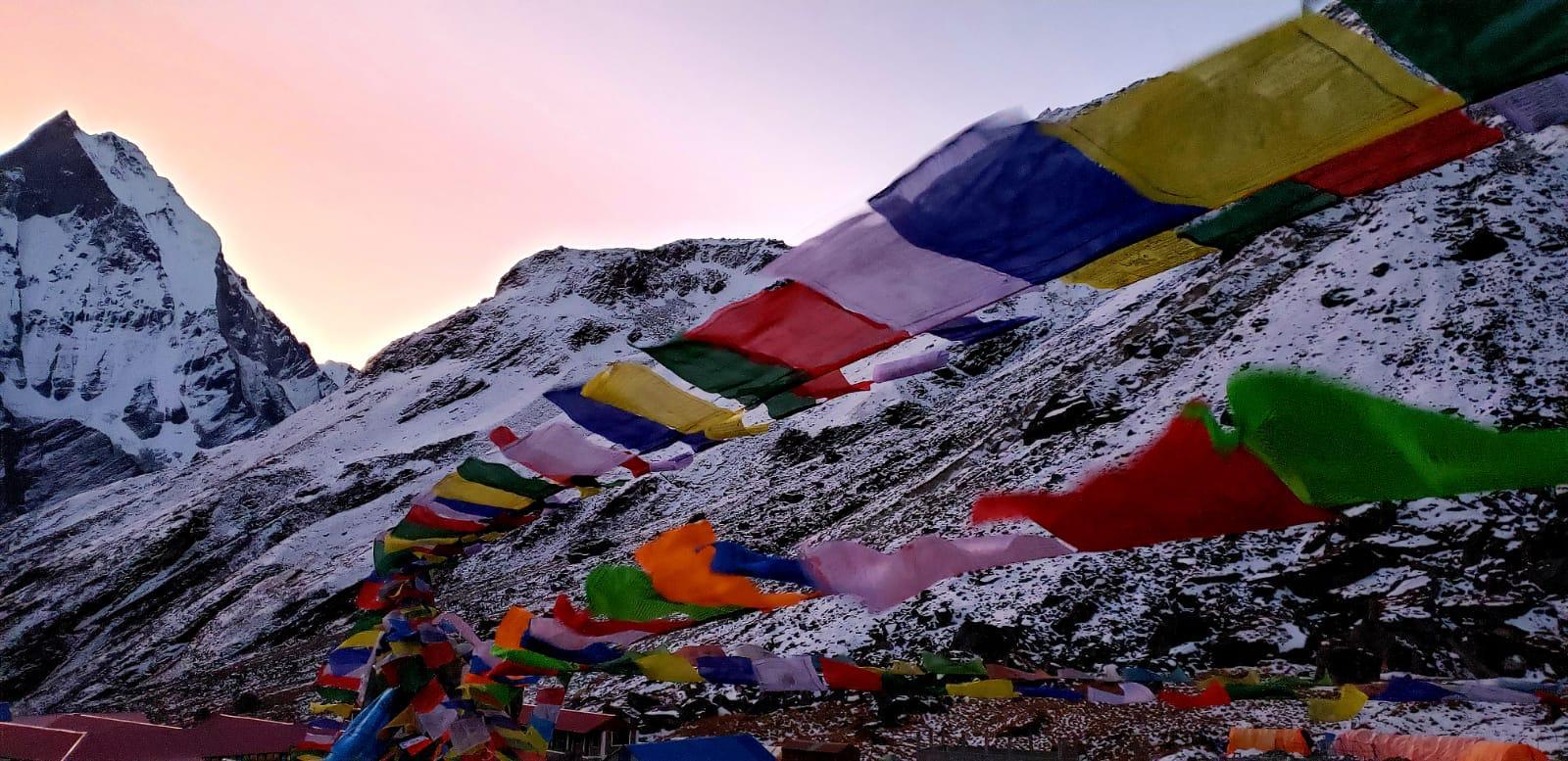
Most of the trekking will enter a region of greater Buddhism. The first sign of their entry into a Buddhist village are the colorful prayer flags that plow through the houses, the monasteries and the peaks in the wind. You will also reach the stupa (Buddhist shrine), the walls of Mani (Sanskrit mantras on large stone walls and slate) or the long walls of prayer wheels. Always walking through these religious monuments on the left is a sign of custom and respect.
Acute mountain sickness (AMS)
AMS is a big problems for new hikers at relatively high altitudes. How is your body responding? Are you sick? Since it is difficult for most of us to train and prepare at that level, it is a real concern for everyone, but without any undue attention. After 22 years of guided tours in the Himalayas, the key to giving yourself the keys to a safe, comfortable and successful trip.
a) Self-control: it should be a fun party, not a sporting event. Stop at the hotel for a cup of tea, take pictures and sit on the snowy peaks with having fun.
b) Maintain adequate humidity: drink liquid until it comes out through the nose and ears. Try to keep your body warm by drinking the various soups and hot water.
These are the some information about the trekking in Nepal. After you arrived into to airport, if you have already booked your trip you will get the enough facilities. Your company will do all the help for you so you should not be worried about your trek. Moreover, Nepal is safe land for travel .We just belief on the peace. If you want to book the trip it’s better to consult with the tour operator of the Nepal.
Finally, you should be updated about the latest changes of Nepal. After October 28, the traffic police has made one good rules with the collaboration with ministry of tourism. This is best for many tourists in Nepal. They have announced Thamel as a Vehicle free Zone. You can walk around the Thamel without any anxiety .This is latest information about the Thamel. Now, you need to walk some minutes to enter your Hotel from the main street. Nepal always welcome and respect the visitors with the lofty tone NAMASTE
Feel Free To Contact Us For Package Details, Price and Any Other Useful InformationContact Us
Everest Base Camp Weather and Altitude
 Everest base camp is well known and famous for challenging trek in Khumbu region of Nepal. The trek offers you majestic vista of high snowy and shining mountains, dense forests, amazing landscapes, a moment to observe lifestyle of Sherpa the world great climbers, to explore yourself base camp along with world heritage site (Sagarmatha national park), panorama of wide variety of flora and fauna that are found nowhere in the globe and the ancient big monasteries that existed since many years. To trek in this region weather and altitude is most important factor which you must know prior to the trek. The Everest base camp is particular destination to which enthusiastic hikers, trekkers and adventure lovers from all over the globe visit just to make it to this camp and experience lifetime achievements. Everest base camp is generally the highest place any willing travelers can go. The ascent via the southeast ridge begins with a trek to Base Camp at altitude of 5,380meters (17600ft.) on the south side of Everest in Nepal. Expedition members usually fly into Lukla (2,860 m) from Kathmandu and pass through Namche Bazaar. Most of novice trekkers feel altitude sickness because of base camp situated at high altitude. To experience and enjoy full on the trails of the trek you must be prepared prior to your trek. Daily more than an hour’s walk up to 2 months and health fitness would be advantage and prevention for altitude and uphill sickness.
One of the most irregular elements of the Everest region is its weather. If you’re not properly prepared for the unpredictable conditions that are likely to occur in this majestic region, you might find yourself in an uncomfortable and unpleasant situation. Usually, the nights are much cooler and very favorable than the daytime hours in the Everest region. Many first-time trekkers are surprised to learn about the incredible range that may occur in a given day. During the day, the thermometer normally shows the temperature as high as 25 degrees Celsius, and can decrease down as low as -20 degrees Celsius in less than 24 hours. There’s no absolute way to know exactly what each day in the mountains will bring but the weather and temperature ranges are likely to be slightly predictable based on the month and season. You have to learn about weather forecasts and properly understand the meaning of those forecasts before you decide to venture off into the mountains. Given the fact that Everest base camp climate is very low, it is not the biggest issue every climber faces. The biggest issue faced by those climbers is the occasional forceful hurricane winds that will start developing and have a rate of development of at least 285 km every hour. These scary winds are not as forceful and wild during the month May, which makes it the ideal short time for the maximum of the climbers to try and climb the Everest summit.
The weather and climate Everest region is one of extremes. Temperatures at the summit are never above freezing and during January temperatures can drop as low as -60° C (-76° F). Despite the low temperatures the biggest issue faced by climbers are hurricane force winds and wind chill. When the jet stream dips south during the winter hurricane force winds may develop reaching more than 285 km/h (177 mph). These winds relax in the month of May and most climbers try to attempt the peak during this short window. The weather varies from one season to another in Everest base camp region.
.Winter Weather at Everest: Winter weather (Nov to Feb) is dominated by the southward migration of the northern hemisphere jet stream which brings high winds, cold temperatures and on occasion heavy snow falls. Winter can be a great time for trekking as the crowds trying to avoid the cold clear out. Day temperatures are comfortable and sunny skies generally prevail although it can get well below freezing at night. The cold and dark winter season at the Everest base camp region starts in late November and lasts up to the end of February.
. Spring (pre Monsoon) Weather: March until the unset of the Monsoon is one of the ideal times to trek. Spring happens to be one of the best times of the year to visit the Everest region, although this can create unnecessary and uneasy crowd at the region. Rain is infrequent and day temperatures are warm. Lots of trekkers and climbers are out in t-shirts. During springtime, the average temperature is 17 degrees Celsius with a maximum of 25 degrees Celsius during sunny days and a minimum of -15 degrees C in the morning and at night for areas above 4000 meters.
. Monsoon Season Everest: The summer weather (June to Sept) is influenced by the Indian Monsoon which brings frequent rainfall and cloudy days. You might find solitude during this time but clouds and rain generally obscure the peaks and it’s not a good time to visit.
. Fall Weather (post Monsoon): The Fall season from the end of the Monsoon until temperatures get cold in December is a great time for trekking with generally clear days and comfortable temperatures.
After all the perfect timing and recommended travel to this region is between June and September as once the monsoon sets in as generally cloudy weather and rain obscure the peaks and you might be lucky to even see mighty Everest. The Everest base camp trek is full of pain and pleasure ahead. The amazing accomplishments of the trek will make you forget all the pain and difficulties during the trek.
Everest Base Camp Trek Difficulty – How Difficult is the Everest Base Camp Trek?


Everest Base Camp Trek Difficulty, trekking to Everest base camp is a lifetime adventure and life changing for many people. Just because you are not stepping foot on the summit of Mount Everest does not mean the Everest Base Camp Trek is easy. It is achievable for most people, but it is not simply a tourist walk. The trek demands respect, preparation, proper training, and determination.
There will be moments when you question your sanity and wonder why you ever decided to take on this challenge. But those thoughts quickly disappear when you witness the majestic Himalayan scenery. The landscape changes dramatically from lush green forests, dense woodlands, glistening blue rivers, and waterfalls to barren alpine terrain, glaciers, and icy lakes. By the end of the journey, you’ll realize it was one of the best decisions of your life.
The Everest Base Camp Trek is one of the hardest physical and mental challenges many people will ever undertake. However, once you reach Everest Base Camp, every difficult step turns into one of your proudest and most unforgettable achievements.
There are several key factors that contribute to a safe, successful, and enjoyable journey through the Khumbu Valley, including proper acclimatization, trekking in low-oxygen environments, and following a well-planned itinerary.
Check Everest Base Camp Trekking Package
Everest Base Camp Trek Difficulty – How Difficult is the Everest Base Camp Trek?
The Everest Base Camp Trek is one of the most exciting, adventurous, challenging, and rewarding treks in the Khumbu region of Nepal. Reaching the base of the world’s highest mountain and experiencing its incredible beauty is a truly unforgettable experience.
For those planning this incredible journey, one of the most common questions is: How difficult is the Everest Base Camp Trek?
The main factors that determine the difficulty of the trek include:
- Physical fitness
- Altitude
- Trek duration
- Trail conditions
- Proper training and preparation
- Physical Fitness Required for Everest Base Camp Trek
Good physical fitness is essential for successfully completing the Everest Base Camp Trek. If you have existing health issues or poor fitness, the trek can become much more difficult and may even become dangerous.
The fitter you are, the more you will enjoy the trek.
Generally, if you can comfortably walk for 4–5 hours a day while carrying a light daypack, you should have no major fitness concerns.
Check Everest Base Camp Trekking Package
Altitude – The Biggest Challenge of Everest Base Camp Trek – Everest Base Camp Trek Difficulty –
Altitude is undoubtedly the most difficult and underestimated aspect of the Everest Base Camp Trek.
If it weren’t for the altitude, the trek itself would be relatively straightforward. Unfortunately, altitude is something you cannot train for completely.
At Everest Base Camp (5,364m), there is approximately 50% less oxygen than at sea level, making every step more physically demanding.
Altitude sickness should never be underestimated, especially at the elevations reached during the trek.
The journey begins at Lukla (2,860m), which is already high enough for some trekkers to experience symptoms of altitude sickness. From there, the trail gradually ascends through the Khumbu Valley until reaching Everest Base Camp. On the return journey, most trekkers climb Kala Patthar (5,545m), the highest point of the trek and the best viewpoint for Mount Everest.
The key to successful high-altitude trekking is proper acclimatization. To reduce the risk of altitude sickness:
- Walk at a slow and steady pace.
- Follow a well-designed itinerary.
- Gain altitude gradually.
- Take scheduled acclimatization days.
- Eat nutritious food.
- Drink plenty of water.
- Get enough rest.
Although the distance from Lukla to Everest Base Camp can technically be completed much faster, doing so significantly increases the risk of altitude sickness. A slower itinerary is both safer and more enjoyable.
The Everest Base Camp Trek is only dangerous if trekkers ignore acclimatization guidelines or travel without experienced guides. A knowledgeable guide ensures proper pacing, adequate rest days, hygienic food, safe drinking water, and monitors trekkers for symptoms of altitude sickness. Unlike technical mountaineering, there are no exposed climbing sections or ropes involved on the standard Everest Base Camp trail.
Cost Increases with Altitude – Everest Base Camp Trek Difficulty
Altitude also affects your budget.
As you trek higher into the Himalayas, the cost of food, accommodation, and other services increases significantly because supplies must be transported by porters, yaks, or helicopters.
Prices don’t just double, they often triple.
It is advisable to carry some energy snacks and enough extra cash for personal expenses during the trek.
Trek Distance and Trail Conditions – Everest Base Camp Trek Difficulty
The Everest Base Camp Trek covers approximately 130 km (round trip).
Although this sounds like a long distance, most guided itineraries spread the trek over around 9 trekking days, averaging approximately 15 km per day.
However, this is not a flat walk.
The trail consists of:
- Rocky paths
- Stone staircases
- Uneven terrain
- Snow-covered sections (depending on the season)
- Continuous ascents and descents
Combined with increasing altitude and changing temperatures, these conditions make the trek much more demanding than the daily distance alone suggests.
Fortunately, most trekking companies provide porters to carry your main luggage, allowing you to hike comfortably with only a light daypack.
Training for Everest Base Camp Trek – Everest Base Camp Trek Difficulty
The Everest Base Camp Trek is considered one of the most challenging trekking adventures in Nepal.
It is not something most people can complete without preparation.
However, with basic training, even first-time trekkers can successfully reach Everest Base Camp.
Walking for 4–6 hours several times a week for 5–8 weeks before the trek is highly recommended.
Additional training such as stair climbing, hiking, strength exercises, and cardiovascular workouts will make the trek much more enjoyable.
With proper preparation, the Everest Base Camp Trek becomes a challenging yet achievable adventure.
Is the Everest Base Camp Trek Worth It? – Everest Base Camp Trek Difficulty
Despite all its challenges, the Everest Base Camp Trek remains one of the most famous trekking adventures in the world, attracting thousands of trekkers every year.
The journey is physically demanding, mentally challenging, and often exhausting.
Yet every difficult step becomes worthwhile when you finally stand beneath the world’s highest mountain.
The breathtaking Himalayan scenery, the unique Sherpa culture, and the overwhelming sense of achievement make every hardship worthwhile.
As the saying goes, the sweetest pleasure often comes after overcoming the greatest challenge. Reaching Everest Base Camp is an accomplishment that fills you with pride and creates memories that last a lifetime.
Trek with Confidence
At Treks Planner Nepal, our expert mountain guides have maintained a 100% successful trek completion rate with zero casualties by prioritizing safety, proper acclimatization, and personalized care throughout every expedition.
If you’re planning your Everest Base Camp adventure, contact us today for a free consultation. We’ll help you prepare for a safe, enjoyable, and unforgettable journey to the foot of the world’s highest mountain.
History of zero % casualties track record with Expert Mountain guides makes us different from other companies, Do Inquire us for details, don’t hesitate, its FREE
Contact Us For Package Details, Price, Available dates and any other use full information
Cholatse peak climbing
Cholatse better known as Jobo Lhaptshan is regarded as one of the most popular and hardest peak climbing than many other mountain peaks in Khumbu region of Nepalese Himalaya. Situated at the modest height of 6440meters on the shining, gloomy, narrow and ice ridges separating the Gokyo and Khumbu valleys is connected to Taboche (6,501m) by a long ridge and east face consists of Chola glacier. It rises from north of Taboche and south of 5420meters Chola pass which is used by Sherpa’s and trekkers to trek between the Gokyo and Khumbu valleys. The North and East faces of Cholatse can be seen from Dughla, on the trail to Mt. Everest base camp. According to Tibetan ‘Cho’ is Lake, ‘La’ is Pass and ‘Tse’ is peak so Cholatse means exactly ‘Lake Pass Peak’. Cholatse peak climbing starts though a flight from Kathmandu to Lukla airport, one of the most popular aerodrome in the world and then all the way to Gokyo. The south and north face were first successfully scaled in 1982 and 1984 respectively by group trekkers and first solo ascent was accomplished on April 15,2005 by Ueli Steck via the North face side. As peak is hard to climb compared to other trekking peaks and higher mountains, not many climbers have succeeded to climb this peak. The south west ridge is considered to be the easiest route to summit Cholatse peak. If you have mountain trekking, ice, rock climbing skills and physically fit and strong then this trek is recommended for you to witness the majestic adventurous trek. The peak provides you with entire mountainous and overwhelming panorama of Himalaya.
The trail offers magnificent landscapes and amazing views of Khumbu region, splendid view of Mt. Everest, Nuptse, and Lhotse and many more other peaks and lusty view of natural resources. Climbing begins right from Gokyo Ri for much needed acclimatization and then trekking continues to Cholatse base camp and returning from Photse all the way down to Namche with full of energy and accomplishments, the trek concludes at Lukla for final departures to Kathmandu. If you are planning and dreaming of dare adventurous trek in Himalaya then Cholatse peak climbing definitely would be one of them providing you with all the mighty view and unexplainable experience in Himalayas of Nepal.
Dhampus peak climbing
Dhampus peak one of the easier and adventurous trekking peak in Nepal also known as Thapa peak lies in between Annapurna and Dhaulagiri mountain massif. The massive and phenomenal altitude differences between Annapurna and Dhaulagiri ranges make Dhampus peak open spot to observe and witness the landscape trekking and sight vista. It is easy, less technical and suitable for physically fit and climbers seeking to gain and enjoy adventurous trek along with exciting trail of Dhaulagiri circuit. Dhampus peak climbing would always be full of adventure and entertainment as the trekking goes all the way through dense forest and human civilization of highly diversified cultures and pleasant Gurung village. Situated at the modest height of 6012meters, one can witness the huge mountain ranges in the world with continuous heights above 7000meters and 8000meters like Mt. Annapurna, Mt. Machhapuchhare, and Mt. Nilgiri, Tukuche, Dhaulagiri and Tilicho peak. After reaching the summit one can experience the beauty and enormous view of more than thirty various peaks between Annapurna and Dhaulagiri range with the close and majestic view of Tukuche and Dhaulagiri.
Likewise, with amazing trekking experience the itinerary includes the passing of two adventurous snow covered passes, the French Pass (5360m) and Dhampus Pass at (5200m). The summit also provides panoramic views of surrounding peaks and mesmerizing view of whole upper Kali Gandaki. The trek starts from Kathmandu to Pokhara. The Dhampus peak can be summit either by short route via Jomsom or following entire Dhaulagiri circuit trek. The trek follows wide range of traditional villages, rhododendron forests and numerous passes with overwhelming views of Himalayas. With proper acclimatization at base camp leading through paved slope and snow crest to conquer Dhampus peak, all this make you feel and witness the majestic view and adventurous experience in high Himalayas. The itinerary on returning back to Jomsom via Yak Kharka and fly to Pokhara ends with amazing and unexplainable trekking experience in Himalayas.
Trekking and Visiting Nepal during Dashain festival Season
Nepal is a small geographically beautiful country and is world in itself and popular not only for worlds highest trekking peaks but also for its unique ethnics groups, diverse culture and tradition and wide variety of unique festivals. The great and majestic Himalayas, unique culture, tradition and religious festivals and various cast and creed people having unity in diversity had made Nepal known all across the world. There are more than 40 festivals celebrated in Nepal every year. The best about the festivals in Nepal is that all the festivals are celebrated with same enthusiasm and in large numbers as Nepal is multilingual, multicultural and multi-religious country having unity in diversity. Celebrating festivals unite all the diverse cultural background together. Although most of the festivals are religious some have historical significance. Among multifarious unique festivals each having its own identifications, Dashain is one of them better known as Vijaya Dashami is greatest auspicious and longest National festival of Nepal which is usually celebrated during the month of Kartik (late September to early October). Trekking in Nepal during this festival season offers extra advantage to experience and explore the culture, tradition, religious festivals and historical sites.
Dashain is the longest and most auspicious festival in the Nepali Bikram Sambat calendar celebrated by Nepalese people along with their Diasporas throughout the globe. Across the kingdom of Nepal the goddess Durga in all her demonstration are worshipped with manifold pujas, ample offerings, worships and thousands of animal sacrifice for the ceremonial sacred bathing, thus soaking the goddess for days in blood. Goddess Durga Bhawani is highly worshipped during this festival and is believed to be the source of all kind of vital power and strength. In the silver age lord Ram had worshipped to goddess mother Bhagawati Durga to receive power to kill the animosity fiend Ravan. Lastly the goddess mother was pleased by his devotion and he was graced with power to kill the abhorrence demon. Then all the people of earth were relived from his frightening.
People all around the world unite and get together to celebrate the holy festival. All the family members, relatives and friends get together during this festival time. And more noticing, this festival is the unity days to forget all kinds of enmity and unite together in the easy to get along with or like-minded friendships for days to come. The mythological scriptures say more; if he/she is a true Hindu he/she follows this sermon and the lord offers him/her a good blessing’. The festival is ten day long and the important days are the very first day called as Ghatasthapana, the seventh day called as Fulpati followed by Maha Asthami on eight day, Maha Nawami on ninth and on tenth day the Dashami or Vijaya Dashami. Following all these important days the very amazing aids and attempts regarding the worshipping of goddess Durga Bhawani are carried out and performed religiously. As autumn season is all about trekking in Nepal during Dashain festival, starting from September to November, Tihar and chhath another great festival starts few days after the Dashain. They young kids and youngsters enjoys Ping swinging and enjoys ensuring and involving in big festive fairs, as various mela or fair is organized at several places all for fun and entertainment. Likewise there are a lot of new and unique worthwhile festival moments to experience.
Nepal is not a super organized country. That’s the beauty of Nepal. Its unique and different country where you can experience the entire low plain terai land locality, mountain range and Hilly region, each region having its own identification, culture and traditions. Dashain is one of the festivals that make it such a special place to visit and explore you with all never before experiences. Autumn season (September to November) is considered as best trekking season for trekking and visiting in Nepal as this season offers excellent weather and majestic mountain views and best is that it’s also the period of festival as Nepal celebrates the greatest Hindu festival, Dashain followed by Tihar and chhath. The biggest advantage about being in Nepal at Dashain time for tourists is that city roads are virtually empty which provides the best time to experience and explore the cities old heritage sites without usual motorbikes and little cars tearing through them and traffic. Likewise the usual shove and dash of Kathmandu and other popular cities fade. The touts, hawkers and street sellers have all gone home and you can wonder all around the cultural sites, old city and ghats in relative peace. As Nepal is well known and one of the best destinations in the world for enjoying real beauty of nature though mountain and peak climbing, trekking and visiting with wide offering of exploring local culture, traditions and religious festivals. To experience the majestic view and adventurous trekking in Nepal, autumn season offers and sustains the outstanding weather with festive season where you can indulge and explore yourself with diverse culture and Diasporas with variety of trekking itinerary.