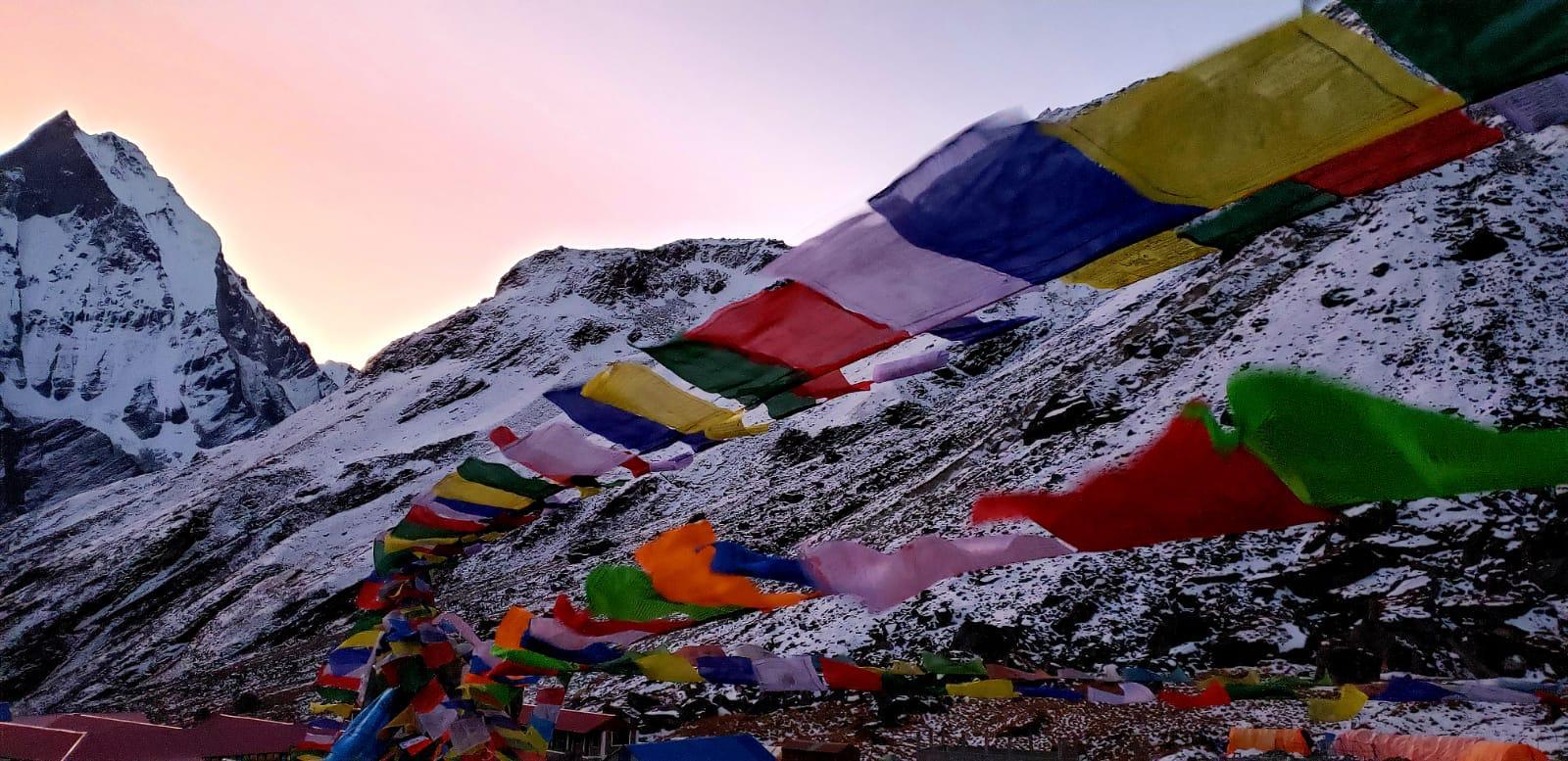


Everest Altitude and Temperature. Everest is a part of the Himalayan mountain range along the border of Nepal and Tibet. It’s located at 27° 59’ North latitude, 86° 55’ East longitude. The official height of Everest is 8,848m (29,029ft). Sifting tectonic plates continue to push Everest upward along with the entire Himalayan mountain range at 1.6 to 3.9 inches (4 to 10 cm per year). In 1841, Sir George Everest, Surveyor General of India, first recorded the location of Everest, and it was named peak XV at that time. In 1865, it was renamed Mount Everest to honor Sir George as the English name. Mount Everest is also known as Sagarmatha in the Nepali Language, which refers to the goddess of the sky, and Chomolungma in the Tibetan language, which refers to the goddess of the universe. Mount Everest is formed by different types of limestone, Shale, and marble. The first person to climb Mount Everest was Edmund Hillary from New Zealand and Tenzing Norgay Sherpa from Nepal on May 29, 1953AD, and Junko Tabei was the first to climb up Everest on May 16, 1975 AD.

One of the most challenging factors is high altitude. As the climber climbs up and increases the elevation, the percentage of oxygen decreases, and the air pressure in the atmosphere, which makes the climber breathe and affects the lungs, kidneys, and brain. It starts with normal symptoms above 4000m high altitude, such as Hyperventilation (extra breathing), increased urination, restless sleep, and periodic breathing at night. Periodic breathing occurs at night, and you feel that you have missed a breath.
At the point of (9,800ft), there is only 2/3 of the oxygen. At an altitude of 20,000ft, there is roughly half, and at the high summit of Mount Everest (29,029), there is only 1/3 of the oxygen. At the high point of altitude, high altitude sicknesses are normally dehydration, flu, fatigue, headache, vomiting, coughing pink, tightness of chest, shortness of breath, discoloration of skin, resting heart beat rate, etc. In this situation, the climber should immediately be taken down to the lower elevation to decrease the altitude sickness. Most of them can also be caused by frostbite, and this usually occurs on the hands and feet, sometimes on the ear and nose, also due to extreme cold.
The tissue turns white, and you lose the feeling in that area after it turns black and finally falls off. So, before that harms you, you can apply the safety measures and keep it warm as much as you can, and use some medicines to decrease the elevation. You should wear your glasses without any carelessness because you may also get caught by snow blindness. Some climbers don’t want to go down, but at that time, it’s beneficial to stay at the lower elevation for the body. The Climber should take the proper pack of the required medicine treatments. The most commonly used medicine for altitude sickness is Diamox, and do not use a sleeping pill, as it is very dangerous at high altitudes. All the required oxygen bottles and all the required things should also be prepared perfectly. The best thing to remember, to be less prone to this sickness, is to gain the best rate of Acclimatization, which is to gain no more than 300m. Drinking alcohol and coffee on the high is just a bad idea and makes you much worse than you might have expected.
These are mainly caused by the low temperature and high altitude. To say about the temperature and weather is one of the extremes. The temperature at the summit is near freezing during January, and temperatures can drop as low as -60° Celsius (-76° Fahrenheit). Another big thing for the climbers, despite the temperature, is hurricane-force winds and wind chill. This wind relaxes in May, and most climbers try to summit the peak at that time. The temperature at the Everest Base Camp also has an average of (-17° Celsius) at the time of the Everest summit, and at the normal time, the summit remains (-37° Celsius). The temperature warms rapidly in the spring month of April. You can also find the weather and temperature forecasting before climbing to Mount Everest. The adjusted wind chill temperature of -70° Celsius is observed on the summit compared to the world’s coldest place of -67.8° Celsius in Siberia and -89° Celsius measured at Vostok in Antarctica. The summit of Mount Everest is one of the windiest and coldest places on Earth. The winds blow at 175 mph+ on the top (category 5 hurricane equivalent).
Winter weather at Everest (Nov to Feb) is dominated by the southward migration of the northern hemisphere jet stream, which brings high winds, cold temperatures, and Heavy snowfall. Winter can be the time for only trekkers, not for climbers. Spring weather from March until the onset of the monsoon is one of the best times to trek, and most people are also on the way to climb during this time. During the monsoon season (June to September), the summer weather is not ideal for trekking and climbing due to frequent rain and cloudy days. Fall weather (post monsoon) until the end of monsoon till December. This time is the best time with clear weather and comfortable temperature. Are you wishing for this? than just visit the climbing agencies and organizations that can help you a lot.
They provide you with the exercise and techniques for 6 months, and then you go for a climb. They provide you with a lot of advanced information on all things. They also provide you with a guide to go climbing along with you. There you can find many agencies like this around you, they also provide you with all the required equipment and tools for climbing, and also provide you with a medicine box. Just seek the best one as that you want looking after the facilities and charges, along with the experiences of the guide that they are providing for you. Catch the best agency and have a safe climb. The best part is that it’s amazing and exciting to climb on Everest, the tallest peak in the world.