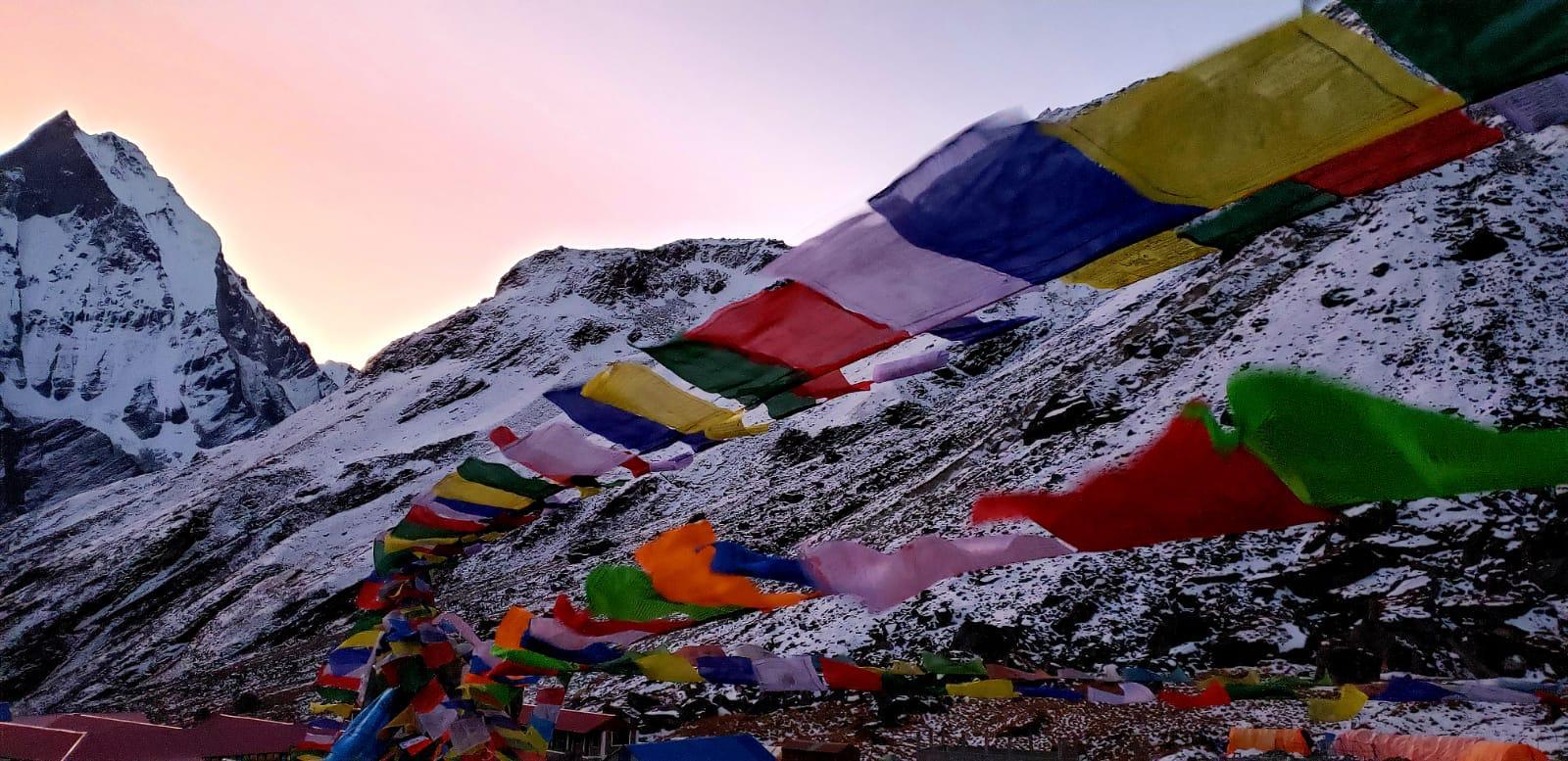


Everest Three Peak Climbing: Everything You Need To Know. The Everest three peaks climbing in Nepal offers an exceptional start to classic Himalaya mountaineering by ascending three prominent six-thousand-meter peaks in a single trip. We will climb three stunning peaks reaching over 6,000 meters (20,000 feet), providing some of the most incredible views in the world.
Join the expedition for a trek across Gokyo Lake, three high passes, and other hidden jewels in the Everest area. Enjoy the incredible experience of climbing Mera Peak (6,476M), Island Peak (6189M), and Lobuche East (6119 m), as well as the mountain and Sherpa cultures.
Mount Everest, Lhotse, Cho Oyu, Makalu, and Kangchenjunga are five 8,000-meter summits that can be seen from the top of Mera Peak, in addition to numerous other Himalayan peaks. The most difficult of the three summits above 6000 meters in this expedition is Island Peak, 6189 m.
Before or after the summit, climbers will ascend or descend a steep 90-degree wall by passing via a steel ladder to span the crevasse holes. Another 6000M summit on the agenda, the Lobuche summit, is moderately difficult yet technically challenging.
Climbing on the Everest Three Peak Climbing of Nepal is a little challenging, with Island Peak being the hardest (2B) climb. Anyone in decent physical shape who has a passion for great adventure can do it.
Starting with Mera Peak and finishing with Lobuche Peak whilst passing via Amphu Lapcha Pass. The Pass connects Mera with the picturesque Island Peak-adjacent Chukung valley.
Overview of the Everest Three Peak Climbing
1. Mera Peak (6,476m) – The Highest Trekking Peak
- Location: Hinku Valley, Makalu-Barun National Park
- Difficulty: Moderate; physically demanding but technically less challenging
- Highlights:
- The highest trekking peak in Nepal
- Panoramic views of Everest, Makalu, Lhotse, Cho Oyu, and Kanchenjunga
- A great introduction to high-altitude climbing
- Climb Style: Gradual ascent on snow slopes with crampons and an ice axe; minimal technical sections
The Mera Peak Climb is for all adventure enthusiasts who have the desire and determination to get the most out of their trip in the Himalayas, since it is the highest trekking peak in Nepal and progresses through a non-technical route.
All you need to get started is a healthy level of fitness. Views of Makalu, Cho Oyu, Kanchenjunga, and other summits and mountains are our reward for completing the climb. One of Nepal’s most beautiful places offers visitors a 360-degree panorama of the country’s shimmering mountains.
2. Island Peak (Imja Tse, 6,189m) – Technical Training Ground
- Location: Imja Valley near Everest Base Camp
- Difficulty: More technical than Mera; requires rope use and glacier crossing
- Highlights:
- Known as a “training peak” for 7,000m and 8,000m expeditions
- Features glacier walks, fixed ropes, ladders over crevasses, and a steep summit ridge
- Stunning views of Ama Dablam, Lhotse, and Everest
- Climb Style: Technical mountaineering skills needed—using a jumar, a harness, and fixed ropes
Island Peak, also known locally as Imja Tse, is a lively and well-known trekking mountain and the ideal starting place for the Everest Three Peak Climbing. Where we can see the stunning panorama of the south faces of Nuptse and Lhotse.
As the path leads us through a scramble of rocks, ridges, and glaciers, climbing Island Peak needs technical expertise. To reach the summit, where we can see Lhotse, Amadblam, and other nearby peaks and summits, we must ascend through a strenuous portion of the terrain.
3. Lobuche East Peak (6,119m) – Rugged & Rewarding
- Location: Near Everest Base Camp, above Lobuche village
- Difficulty: Strenuous; rocky ridges and icy slopes
- Highlights:
- Close-up views of Everest, Nuptse, Pumori, and Khumbu Glacier
- A combination of rock scrambling and ice climbing
- Less crowded compared to Island Peak
- Climb Style: Steep rocky start followed by snow ridges, requiring both rock and ice climbing skills
At the end of the Everest Three Peak Climbing, we will embrace the great challenge of Lobuche, as it will be the most strenuous. Lobuche, which lies close to the Khumbu Glacier, features two noteworthy peaks: Lobuche Far East and Lobuche East. At 6145 meters, Lobuche East is 26 meters higher and somewhat more difficult than Island Peak, yet it is also incredibly rewarding.
Additionally, this excursion will take you to some of the most well-known locations in the Everest area, which provide breathtaking views of Everest and other beautiful landscapes.
The Adventure at a Glance
- Duration: 25–30 days (depending on itinerary and acclimatization days)
- Maximum Elevation: 6,476m (Mera Peak)
- Difficulty Level: Strenuous – requires high physical fitness and prior trekking/climbing experience
- Best Seasons: Spring (March–May) and Autumn (September–November)
Highlights Of The Trip
- Views of well-known peaks, including Mount Everest, Mount Makalu, Ama Dablam, Nuptse, and Baruntse.
- Discover the Sherpa culture in this region.
- experience camping in the Himalayas.
- An exciting glacier walk experience.
- Discover the mountains and glaciers in motion.
- the breathtaking panoramas of the Alpine forests, and the extraordinary landscape.
- Island Peak 6189, Lobuche East 6119, and Mera Peak 6476 meters
- Emerald Lake Gokyo, Everest Base Camp, and Amphu Lhabtsa Pass, all located above 5000 meters
Skills & Requirements
The Everest Three Peak Climbing is demanding. Here’s what climbers should prepare for:
- Physical Fitness: Ability to trek 6–8 hours daily on steep terrain with a backpack
- Altitude Experience: Prior trekking above 4,000m recommended
- Technical Skills: Familiarity with crampons, ice axe, jumar, harness, and ropes
- Mental Strength: Long days, extreme cold, and glacier conditions require resilience
Tip: Many climbers use this expedition as preparation for future climbs like Ama Dablam or Everest itself.
Climbing Difficulty: Everest Three Peak Climbing
This expedition is regarded as challenging and physically taxing. Getting physically healthy is crucial before beginning a trek or climb. Mera Peak, in contrast to the other two summits, is a comparatively simple climb. If you’re in excellent physical shape, we can help and make the climb to the top quite easy. Also, if you’ve experienced higher altitudes before, this is the ideal challenge for you.
The ascent is difficult since it is steep and the air is at its thinnest because you will be ascending the snow-covered peaks at around 6000 meters. Some sections might pose a risk as there will be crevasses covered in snow; however, they will be equipped with ladders to assist you in getting across.
Although it could be alarming, you will always be on safety lines. Fixed lines make the ascending path secure, but it will take a lot of persistence to reach the top ridge. It’s also necessary to use equipment like fixed ropes and crampons. Beginners will receive some crucial instructions.
Accommodation & Logistics
- Tea Houses: Comfortable lodges with meals in lower valleys and villages
- Camping: Necessary for high camps on all three peaks
- Support Team: Professional Sherpa guides, porters, and cook staff are essential for safety and logistics
Meals usually consist of local Nepali dishes, rice, noodles, and soups, with extra emphasis on high-calorie foods at higher altitudes.
Is This Trip Right For You?
This expedition is ideal for adventure seekers who have already trekked at high altitude and want to elevate their climbing skills. It’s challenging but achievable with proper preparation and professional guidance. If your dream is to someday climb an 8,000m giant, this trilogy is the perfect stepping stone.
The ultimate climbing trip, Everest Three Peak Climbing, consists of scaling three peaks above 6000 meters in height and traversing the 5,850-meter Amphu Laptcha Pass. Due to the lengthier duration of the trek/climb involved in the Everest Three Peak Climbing, great physical fitness is needed to participate. A major benefit while climbing a 6000m summit is prior expertise with high altitude excursions and climbing lower peaks.
Although prior trekking or climbing expertise is required, our carefully prepared program also welcomes participants without such a background. We start the journey with an acclimatization hike to Mera Peak, cross the Amphu Lapcha, and then go to Island Peak and Lobuche Peak. For this journey, you also need to be mentally and physically prepared.
It takes teamwork, strong determination, and an intense desire. Our schedule includes plenty of time for acclimatization and a contingency day, and there will also be climbing training at the base camp, so you get the necessary skills before the trip.
Travel Insurance & Safety Measures
All trekkers need travel insurance with helicopter evacuation. Mountain trekking and peak-climbing insurance are now available from several travel insurance companies worldwide. All of our guests are advised to get travel insurance that includes emergency helicopter evacuation in the event of AMS (Acute Mountain Sickness) or for any other reason in high elevations when there are no other transportation options.
Before making a decision, it is recommended to thoroughly research the insurance and its coverages. Bring your insurance documentation with you on the trip, and leave a copy next to your family. You must make sure that your insurance covers you for the relevant actions and offers an acceptable degree of protection.
Gear Checklist
It is advised to bring the equipment specified below on trips. We kindly request that you verify and test each piece of equipment before purchasing it for the trip. They are available in several hiking stores in Kathmandu from well-known brands to small local producers, so you can also buy or rent them there.
Training
Climbing and trekking at high altitudes, particularly in the Himalayas, is difficult and demands that you be in excellent physical, mental, and emotional shape. The trip will be more pleasurable the more fit you are.
Itinerary:
Day 01: Arrival in Kathmandu
Day 02: Fly to Lukla | Trek to Paiya (Chutok)
Day 03: Panggom
Day 04: Ningsow
Day 05: Chhatra Khola
Day 06: Kothe
Day 07:  Thaknak
Day 08: Khare
Day 09: Khare: Acclimatization and pre-climb training
Day 10: Mera High Camp
Day 11: Mera High Camp to Summit and trek to Kongma Dingma (4,850m/15,913ft)
Day 12: Kongma Dingma: rest day
Day 13: Kongma Dingma to Seto Pokhari
Day 14: Seto Pokhari to Amphu Labcha Base Camp (South)
Day 15: Amphu Labcha Base Camp to Chhukung
Day 16: Trek to Island Peak Base Camp
Day 17: Island Peak Summit (6,189m/20,305ft) | Return to Chhukung
Day 18: COntingency Day
Day 19 : Trek to Lobuche
Day 20: Trek to High Camp
Day 21: Climb to the Summit (6, 119m/20,075ft) and back to the High Camp (5398m/17,712ft)
Day 22: Contingency Day
Day 23: Trek to Pangboche
Day 24: Trek back to Namche Bazaar
Day 25: Trek to Lukla
Day 26: Fly back to Kathmandu
Day 27: Buffer Day
Day 28: Departure