Island Peak Expedition: What It’s Really Like to Stand at 6,189m

Island Peak Expedition

Island Peak Expedition: What It’s Really Like to Stand at 6,189m. Standing on the summit of Island Peak (Imja Tse) at 6,189 meters, the world feels vast, silent, and impossibly close. Ama Dablam rises like a cathedral to the west, Lhotse’s icy face looms to the north, and the Khumbu Valley stretches far below in a maze of glaciers and moraines. It’s not just a climb it’s a moment earned step by step, breath by breath.

But what is an Island Peak expedition really like? Beyond the Instagram photos and summit statistics, here’s an honest look at the experience from acclimatization to the final push, and what it feels like to stand on top of your first Himalayan peak.

Why Island Peak Captures So Many Climbers

Island Peak is often described as a “beginner’s” trekking peak but don’t let that label mislead you. While technically accessible, it still demands fitness, mental resilience, and respect for altitude.

What makes Island Peak so popular is its perfect balance:

  • High Himalayan altitude without extreme technical difficulty
  • Stunning views of Everest, Lhotse, Nuptse, and Ama Dablam
  • A genuine mountaineering experience using ropes, crampons, and ice axe
  • Ideal as a first 6,000-meter peak
  • For many climbers, Island Peak is where trekking ends and mountaineering truly begins.

The Journey Before the Climb

An Island Peak expedition isn’t just summit day, it’s a gradual transition from green valleys to a frozen alpine world.

Trekking Through the Khumbu

58373561 2331005073851537 5118780476215001088 n
Island Peak Expedition: What It’s Really Like to Stand at 6,189m 5

Most expeditions begin with the classic trek through:

Lukla

Namche Bazaar

Tengboche

Dingboche

Chukhung

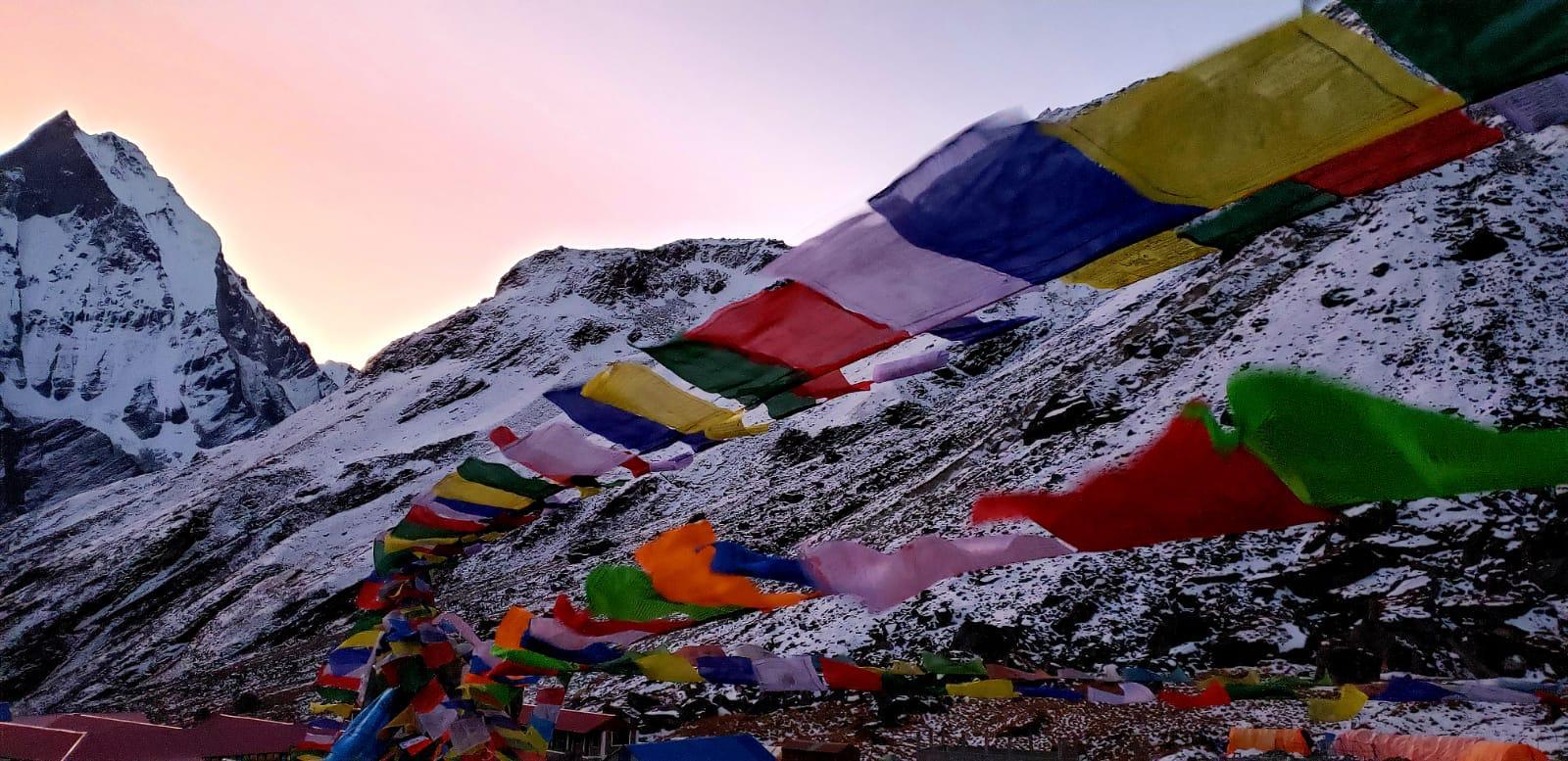
This phase is as important as the climb itself. The slow ascent allows your body to adapt to thinning air, while days are filled with prayer flags, suspension bridges, yaks, and views that never stop improving.

Acclimatization hikes above Dingboche and Chukhung prepare your lungs and legs for what’s ahead.

Life at Island Peak Base Camp

At around 5,100 meters, Island Peak Base Camp feels stark and remote. There are no teahouses here just tents, wind, and the sound of ice cracking in the glacier nearby.

Evenings are quiet:

  • Hot soup and simple meals
  • Gear checks and rope briefings
  • Early nights as temperatures drop fast

You feel the altitude constantly. Simple tasks, changing clothes, melting snow, tying boots, take more effort. Sleep is lighter. Breathing is louder. And tomorrow, the climb begins.

Summit Day: The Hardest and Most Rewarding Day

A Midnight Start

Summit day usually begins between 12:00 and 2:00 a.m. Headlamps glow as climbers rope up and step onto the frozen moraine.

The early hours are mentally demanding:

  • Steep rocky terrain
  • Cold biting through gloves
  • Slow, deliberate movement

Above 5,500 meters, every step feels heavier. This is where mental strength matters as much as physical fitness.

Crossing the Glacier and the Headwall

The climb transitions onto the glacier, where crampons bite into hard ice. Fixed ropes lead up the famous 40–45° ice headwall, the most technical section of the climb.

Here, climbers use:

Jumar (ascender)

Ice axe

Harness and rope

It’s not extreme climbing, but at this altitude, even simple movements feel intense.

Standing on the Summit of Island Peak (6,189m)

WhatsApp Image 2025 03 10 at 15.32.17 778186cc
Island Peak Expedition: What It’s Really Like to Stand at 6,189m 6

The summit is narrow, often just enough space for a few climbers at a time. And yet, the feeling is immense.

You’re surrounded by giants:

  • Lhotse towering above
  • Ama Dablam perfectly framed
  • Makalu in the distance
  • Glaciers flowing far below

Breathing is shallow. The air is thin. But the sense of achievement is overwhelming. For many, it’s the highest point they’ve ever stood—and one they’ll never forget.

Summit time is short. Safety comes first. After photos and quiet reflection, the descent begins.

The Descent: Often Harder Than the Climb

Most accidents happen on the way down, when fatigue sets in. Descending the headwall requires focus and steady movement. Once back at base camp, exhaustion turns into relief—and celebration.

That first hot drink after returning feels extraordinary.

Who Is Island Peak Really For?

Island Peak is ideal if you:

  • Have prior high-altitude trekking experience
  • Are comfortable hiking 6–8 hours a day
  • Want your first true mountaineering summit
  • Are prepared to train before the expedition
  • It’s challenging, but achievable with proper preparation and a responsible itinerary.

What Island Peak Teaches You

More than the summit, Island Peak teaches:

  • Patience with altitude
  • Respect for mountains
  • Trust in your team and guide
  • Confidence in your own limits

Standing at 6,189 meters changes how you see effort, discomfort, and reward.

Final Thoughts: More Than Just a Peak

An Island Peak expedition is not about ticking off a height, it’s about transformation. From your first step on the Khumbu trail to that quiet moment on the summit, the mountain strips life down to essentials: breath, movement, and purpose.

If you’ve ever wondered what it’s really like to stand at 6,189 meters Island Peak offers an answer you’ll carry for a lifetime.

GROUP JOINING IN ISLAND PEAK CLIMBING

Group Joining Island Peak

Group joining in Island Peak Climbing. One of the most popular summits among mountains above 6000 m in elevation is Island Peak, also known as Imja Tse in the local Sherpa language. The British Expedition gave this unusually formed peak the name “Island Peak” because, as seen from Dingboche, it appeared to be an island in the middle of a sea of snow and ice. Every climber who travels through the Everest region is enticed and drawn to it.

As it is easier than summits over 7,000 meters, Island Peak is one of the top targets for potential climbers yet it provides a similar sense of fulfillment and accomplishment upon summiting.

For those who have some high-altitude experience and wish to broaden their views of the Himalayas, Island Peak is the ideal choice. Although the Himalayas have an easier beginning, climbers must still have some stamina because they must traverse several crevasses that include parts of snow and ice. However, it is a great chance to develop climbing abilities and be ready for the peaks of 7000 and 8000 meters.

The trail to the island peak is the classic Everest Expedition trail till Dingboche. From there, climbers of Island Peak and other summits turn in the direction of Chhukung, while those of Everest, Lhotse, and other peaks turn in the direction of Lobuche, leading to the Everest Base Camp. The whole experience is captivating and intriguing. The ultimate delight of being in the Himalayas is seeing the magnificence of mountain panoramas right in front of you and the wind of the snow. The stunning plants and animals in the Sagarmatha National Park along the path will equally fascinate you.

BEST TIME FOR CLIMB

The months of September through November and March through May are the finest times of year to climb the Island Peak/Imja Tse. These times of year are ideal for climbing because the routes are unobstructed and clear, and the views are clear.

WHAT IS AN ISLAND PEAK TREKKING GROUP?

An exciting and gratifying way to begin a Himalayan trip is by joining a group on an Island Peak trek. A group joining trek enables individual trekkers and climbers to get together as a team for a particular trekking or climbing adventure, as opposed to private excursions where you establish your own group. These teams are typically put together by trekking organizations or travel agencies, who connect together explorers with similar interests to share the trip and expenses.

Group trekking provides a double adventure at a low cost. You’ll meet adventurous travelers from all over the world and socialize with multilingual and multicultural people. The language of communication for the group going on the walk will be English.
For several trekking regions, we have set group joining departure dates. It is the ideal choice for solo travelers looking for a group to hike with and climb in Nepal. Group joining trekking and climbing in Nepal will be less expensive than private treks or climbs since you will likely share all expenses that are associated with the whole expedition, including meals, housing, transportation, guides, and porters.

BENEFITS OF GROUP JOINING IN ISLAND PEAK CLIMBING:

COST EFFECTIVE:

Joining a group trip has several benefits, one of which is cost-sharing. The cost of an expedition might be high, but when you travel with a group, you can divide the cost of equipment, guides, and other fees, which makes the trip cheaper.

SAFETY AND SUPPORT

Climbing Island Peak demands technicality, acclimatization, and the proper equipment. Being a part of a group adds an extra layer of protection and support since you can lean on knowledgeable leaders and other climbers for encouragement when things become tough.

UNITY:

Group joining treks encourages participants to feel a sense of togetherness. Together, explorers from all over the world forge enduring friendships and cherishable experiences by experiencing the highs and lows of the trip together.

LOGISTICAL CONVENIENCE:

It might be difficult to plan a hike to a distant area like Island Peak on your own. Group joining treks simplify the procedure simpler because the tour operator handles the necessary paperwork and arranges for lodging, food, and transportation, freeing the participants to concentrate exclusively on the expedition.

GREATER ADVENTURE:

A group’s unity while embarking on a trip improves the entire adventure experience. The trip becomes more meaningful and joyful as people encourage one another and share inspiring experiences.

WHY ISLAND PEAK CLIMBING IS THE ULTIMATE CHOICE?

For climbers looking for a challenging and rewarding Himalayan journey, climbing Island Peak is perhaps the best option. Island Peak is regarded as a good choice for a number of reasons:

SPECTACULAR LOCATION:

Mount Everest, Lhotse, Nuptse, and Makalu are just a few of the highest and most famous mountains in the world that can be seen from Island Peak, which is situated in Nepal’s Everest region. The Khumbu Valley and the surrounding landscapes’ pristine beauty add to the climb’s attractiveness.

HIGH ALTITUDE:

Despite being a difficult climb, Island Peak’s altitude of 6,189 meters (20,305 feet) is reachable for climbers with some expertise and the right acclimatization. It is a great starting point for anyone who wants to climb greater peaks in the future.

CHALLENGING YET ACHIEVABLE

Island Peak is not an easy mountain to climb; it needs some technical climbing expertise, making it a desirable option for climbers looking to improve their mountaineering skills. Reaching the peak is an endeavor because the ascent includes ice and rock climbing parts.

MIXTURE OF TREKKING AND CLIMBING:

The Island Peak adventure involves both climbing the peak itself and trekking to Everest Base Camp. Climbers may enjoy the vibrant Sherpa culture, breathtaking scenery, and the rush of reaching a Himalayan peak all in one trip thanks to this special combination.

CULTURAL IMMERSION:

The walk to Island Peak passes via old monasteries, vibrant prayer flags, and traditional Sherpa settlements, providing a really cultural experience. The adventure takes on a unique dimension as a result of interactions with the local Sherpa community.

EXPERIENCED TEAM:

There is an additional layer of safety and support when climbing Island Peak with a knowledgeable guide and in a group. The guides are knowledgeable about the area and equipped to tackle any unanticipated difficulties that may arise.

GROUP JOINING OPTION:

Individual climbers who lack a committed team or who do not wish to cover the full expense of a private expedition can now climb Island Peak thanks to the availability of group joining treks. The friendship and encouragement of other climbers enhance the entire journey.

THE SENSE OF ACCOMPLISHMENT:

Reaching the summit of Island Peak is an impressive accomplishment that climbers will never forget. It offers a sense of achievement and empowerment, igniting the urge to embark on future excursions that are more difficult.

Climbing Island Peak is without a doubt the best option for climbers seeking an amazing trip that combines breathtaking scenery, technical difficulties, cultural immersion, and the exhilaration of achieving a Himalayan peak. Island Peak offers a thrilling adventure that will leave you with lasting memories and a great feeling of success, regardless of whether you are a seasoned climber or a passionate trekker with the goal of climbing higher.

GROUP JOINING DATES:

ISLAND PEAK 20 DAYS26 SEP 2023USD 2235/-
ISLAND PEAK 20 DAYS02 OCT 2023USD 2135/-
ISLAND PEAK 14 DAYS15 OCT 2023USD 2000/-
ISLAND PEAK 20 DAYS21 OCT 2023USD 2235/-
ISLAND PEAK 18 DAYS01 NOV 2023USD 2135/-
Group Joining Dates for Autumn 2023

CONTACT US FOR MORE DETAILS

ISLAND PEAK VS MERA PEAK CLIMBING: HOW TO CHOOSE THE RIGHT PEAK?

Island Peak Climbing

Island Peak Vs Mera Peak Climbing: How to Choose the right peak. One of the most popular trekking peaks in Nepal is the Mera Peak and Island Peak. These summits are among the top options for novice mountain climbers just getting started. These two mountains are among the most prominent trekking peaks in Nepal. But, many climbers find it difficult to choose between these two peaks. We have created a thorough guide for Mera Peak and Island Peak to help beginner climbers to choose the right peak for them. Both peaks do not necessitate a specific level of mountaineering expertise, but many other characteristics set them apart. Mera Peak is considered to be the simpler one to scale from a safety perspective, while Island Peak offers more exhilaration from mountain climbing.

QUICK FACTS: ISLAND PEAK VS MERA PEAK CLIMBING

TOPICISLAND PEAKMERA PEAK
ALTITUDE6189m/20305ftMera North: 6476m/ 21247ft
Mera Central: 6461m/21198ft
Mera South: 6065m/ 19898ft
ACTIVITYTrekking/ClimbingTrekking Peak/Climbing
DIFFICULTYModerate to StrenuousModerate
REGIONKhumbu Mahalangur Himalaya
CLIMBING GRADEThe French and Swiss Alpine Climbing Classification System – PD + ‘Per Difficult’The French and Swiss Alpine Climbing Classification System – F’ Facial Easy’
NATIONAL PARKSagarmatha National ParkMakalu Barun National Park
TREKKING PEAK2nd Highest Trekking PeakHighest Trekking Peak
PERMITSIsland Peak Climbing Permit
Sagarmatha National Park
Khumbu Region
TIMS Card
Mera Peak Climbing Permit
Makalu Barun National Park
TIMS Card

HIGHLIGHTS: ISLAND PEAK VS MERA PEAK CLIMBING

ISLAND PEAK HIGHLIGHTSMERA PEAK HIGHLIGHTS
1. Explore the amazing Khumbu region.1. Explore the isolated Hinku Valley.
2. From Island Peak’s summit, you can see Makalu (8,475 meters) in the east, Baruntse, and Ama Dablam in the south, and the enormous peaks of Nuptse (7,879 meters), Lhotse (8,501 meters), Lhotse Middle Peak (8,410 meters), and Lhotse Shar (8,383 meters), which form a semicircle to the north.2. Witness five of the world’s tallest mountains above 8000 meters, including Cho Oyu (8,201 meters), Lhotse (8,516 meters), Everest (8,848 meters), Kanchenjunga (8,586 meters), and Makalu (8,463 meters).
3. Discover Sherpa ethnic towns, some of the most endangered wildlife in the Himalayas, and magnificent Himalayan green forests with rhododendron, magnolia, birch, and pine.3. Discover the unique Himalayan species, rhododendron, magnolia, birch, and pine woods, as well as Sherpa culture, traditions, and customs.
4. Wander through the revered religious places in the Khumbu valley, such as Tengboche Monastery, Khumbu Monastery, and a great number of chortens, and prayer wheels..4. Walk through sacred Buddhist temples, monasteries, chortens, gompas, mane walls, prayer wheels, and fluttering prayer flags.
5. Cross Kongma La pass and then go across the Lhotse Glacier.5. Cross Zatrwa La Pass (4600 m/14720 ft.)

SIMILARITIES BETWEEN MERA PEAK AND ISLAND PEAK CLIMBING

The Barun sub-section of the Mahalangur region of the Nepalese Himalayas contains Mera Peak and Island Peak. Both summits are almost the same height; Mera is 6,461 meters (21,190 feet) tall while Island is 6,189 meters (20,305 feet). The two summits are also quite close to one another. Both Mera and Island are trekking peaks that don’t call for specialized climbing expertise. Despite their many similarities, Island Peak and Mera Peak both have unique adventures to offer travelers.

DIFFICULTY: ISLAND PEAK VS MERA PEAK CLIMBING

ISLAND PEAKMERA PEAK
The difficulty of Island Peak is somewhat higher than that of Mera Peak. In terms of technical difficulty, the summit is a little tougher than the Mera summit. Except that the two climbs are quite similar to one another.

For beginning and novice climbers, a trekking peak is the best choice. If you have basic knowledge of climbing it would be a plus point as island peak climbing is a little tricky. There are headwall and icefall parts, as well as crevasses and narrow ridges. Therefore, you will not have any trouble using gears like ropes, ladders, crampons, axes, etc. Additionally, no specific prior technical knowledge is required to climb Island Peak.

Major difficulties include trekking at high altitudes, lengthy trekking days, steep paths, harsh terrain, severe weather, and snowy terrain. For Island Peak climbing, you need to be physically fit and have an excellent basis for climbing.
According to the Nepal Mountaineering Association, Mera Peak is considered a trekking peak. Peaks in this category have little or no challenging aspects, which perfectly suit the requirements of beginners.

The ascent is quite straightforward because this summit has no challenging aspects. Climbers with some basic climbing experience and good stamina can opt for this climb. For Mera Peak, prior climbing experience is not necessary. Mera Peak is less complicated than Island Peak in comparison. There are no crevasses or narrow ridges; only ice climbing and trekking.

Trekking in the region’s high terrain for several weeks is required for the climb of Mera Peak. Its main difficulties are high altitude, steep hills, rugged terrain, icy and snowy trails, lengthy trekking hours, and isolated areas.

ROUTE: ISLAND PEAK VS MERA PEAK CLIMBING

ISLAND PEAKMERA PEAK
An exceptional fusion of a mountaineering trip with trekking can be experienced in the Island Peak climbing. The route takes the traditional Everest Base Camp Trek route and adds a climbing route to High Camp and ultimately the summit. In comparison to climbing Mera Peak, the summit stage of this climb involves a vigorous rise and is thus a little more difficult and tricky. Island Peak ascent takes place over the course of 15 days. Additionally, if you wish to hike to Kala Patthar and Everest Base Camp, the itinerary is extended to 18 or 20 days.Prior to ascending the summit, climbers have to trek for almost a week to reach Mera Peak High Camp (5,780m ). Through the lush jungle and secluded valleys, the trekking trails extend to Hinku Valley. The path goes on from Lukla to Hinku Valley. The main resting areas before Mera High Camp are Paiya, Kothe, Panggom, Thankak, and Khare. From the camp, gradually climb to the peak using jumars and a fixed rope. The hike and ascent up Mera Peak may be completed in roughly 13 – 18 days.

BEST SEASON FOR CLIMBING MERA AND ISLAND PEAK

Mera Peak and Island Peak are said to be best conquered in the spring and fall. The best times to ascend to the top are in late April, early May, as well as in September, October, and November. And if you want us to be more precise, the ideal months for a climbing excursion are October and May. Mountaineering is seen as being out of season during the winter and monsoon. Despite this, some climbers attempt to reach the summit during the winter. The disadvantages of climbing in the off-season include the need to be prepared for unanticipated events that are associated with adverse weather, such as heavy snowfall, the potential for aircraft delays and cancellations, and decreased visibility.

Spring and fall offer the greatest views of the mountains since the weather is steady and the sky is clear. The best weather for climbing is present throughout the day in spring or fall. For the finest climbing experience, especially for beginning climbers, climbing during the ideal season is crucial.

Island peak (Imja Tse) climbing via Everest base camp

Island peak also known as Imja Tse is one of the most fascinating peak climbing of the Everest region. The journey starts and concludes at one of the most famous aerodrome in the world, the Lukla airport in the Everest region. The peak was named as ‘Island peak’ in 1951 by Eric Shipton since it appears as an island in a sea of ice seeing it from Dingboche.

Imja Tse, better known as Island Peak, is a mountain in Sagarmatha national park of the Himalayas of eastern Nepal. The peak was named Island Peak in 1951 by Ship ton’s party since it appears as an island in a sea of ice when viewed from dingboche. The peak was later renamed in 1983 to Imja Tse but Island Peak remains the popular choice. The peak is actually an extension of the ridge coming down off the south end of Lhotse shar. Climbing Island peak via Everest base camp is most fascinating and fantastic experience in the Himalayas. As it is designed and permitted for all the new climbers and those with having passion of climbing and trekking Himalayas or mountain with very little technical aspects. It is regarded as one of the most preferred 6000m trek for energetic and physically fit trekkers to ensure the incredible world of mountain climbing.

It is known as one of the major peak climbing in Everest region (with modest height of 6,189m) in Nepal with magnificent and highly glaciated west face that rises from Lhotse glacier. Every year thousands of climbers from all across the world flock to Nepal to get permit for Island Peak Climbing. The friendly and cooperative Sherpa’s and their culture, the panorama view of Khumbu valley are all the luring and splendid experience and accomplishments of the trek. The adventure with proper and moderate acclimatization at worthy intervals, takes us also to one of the most popular trekking destination in the world i.e. Everest Base camp (5357m) and Kalapatthar for the nearest view of Mt. Everest and various other high mountains. The best time to trek in this region is from spring season (March to May) and autumn season (October to December).

Contact Us

NOTE: FREE CLIMBING GEARS PROVIDED